Ergoactives Ergobaum vs. Millennial Medical In Motion Pros
A Comparative Review by guest writer Virginia

I’m Virginia, a long-time listener, first-time caller. I reached out to Amy to share my review of the Ergoactive Ergobaum 7G forearm crutches, as I had an opinion to share with the world, but as I’m not a blogger, I had nowhere to put it. Thank you to Amy for allowing me to use her platform!
I’m a part-time forearm crutch user due to chronic pain and I’ve used a pair of Ergoactives since 2025. Before that, I used two very inferior plastic forearm crutches that I’d picked up off a neighborhood curb for the budget price of zero dollars. You get what you pay for, and these had no shocks, hard cylindrical grips, and open cuffs (which I modified with a soft velcro strap taken off a medical walking boot I had no more use for). These were a huge improvement over the various walking canes I had tried, but my thumb and hand ached after using them and the lack of a proper closed cuff irritated me, so over the winter I went all in for the Ergoactives.
Now, my thinking with the Ergoactives was thus. I intuited that the reason my free crutches (henceforth “Freebies” as I don’t know the brand) were so noticeably better than a cane was because I was no longer putting weight directly and solely into my hands when walking, and instead, some of the weight was put into my forearm in the long open forearm cuff. When I was looking at other forearm crutch brands, considering an upgrade, all of the closed cuff brands I saw did not have the same length forearm cuff; just a post connecting the hand grip and the ring-like cuff. My assumption was that those closed cuff crutches would feel just like two canes that hang onto your arms. This was why I turned to the Ergoactives. They had the full forearm cradle I wanted (and it was padded instead of being hard plastic), and on top of that, they had a plastic strap to allow the crutches to hang off your arms like the other brands. They combined the best of both worlds, or so I thought. So after scouring the web for every review I could find, I weighed the evidence and bought them.
And… they were great! I have used them very happily for the past four months. But in the past few weeks several factors have converged that led to it being ideal for me to pick up another pair of crutches immediately, so a few weeks ago I became the proud owner of a refurbished pair of Millennial In-Motion Pro forearm crutches. And here we come to the crux of the guest post: how the Ergoactives stack up next to the Millennials. I will spoil it for you and tell you now that in retrospect, most of my love for the Ergoactives came from the fact that they were not made of hard plastic and could go hands-free (i.e., they were an upgrade from my Freebies, and remarkable mostly for that) — they don’t actually beat the Millennials.
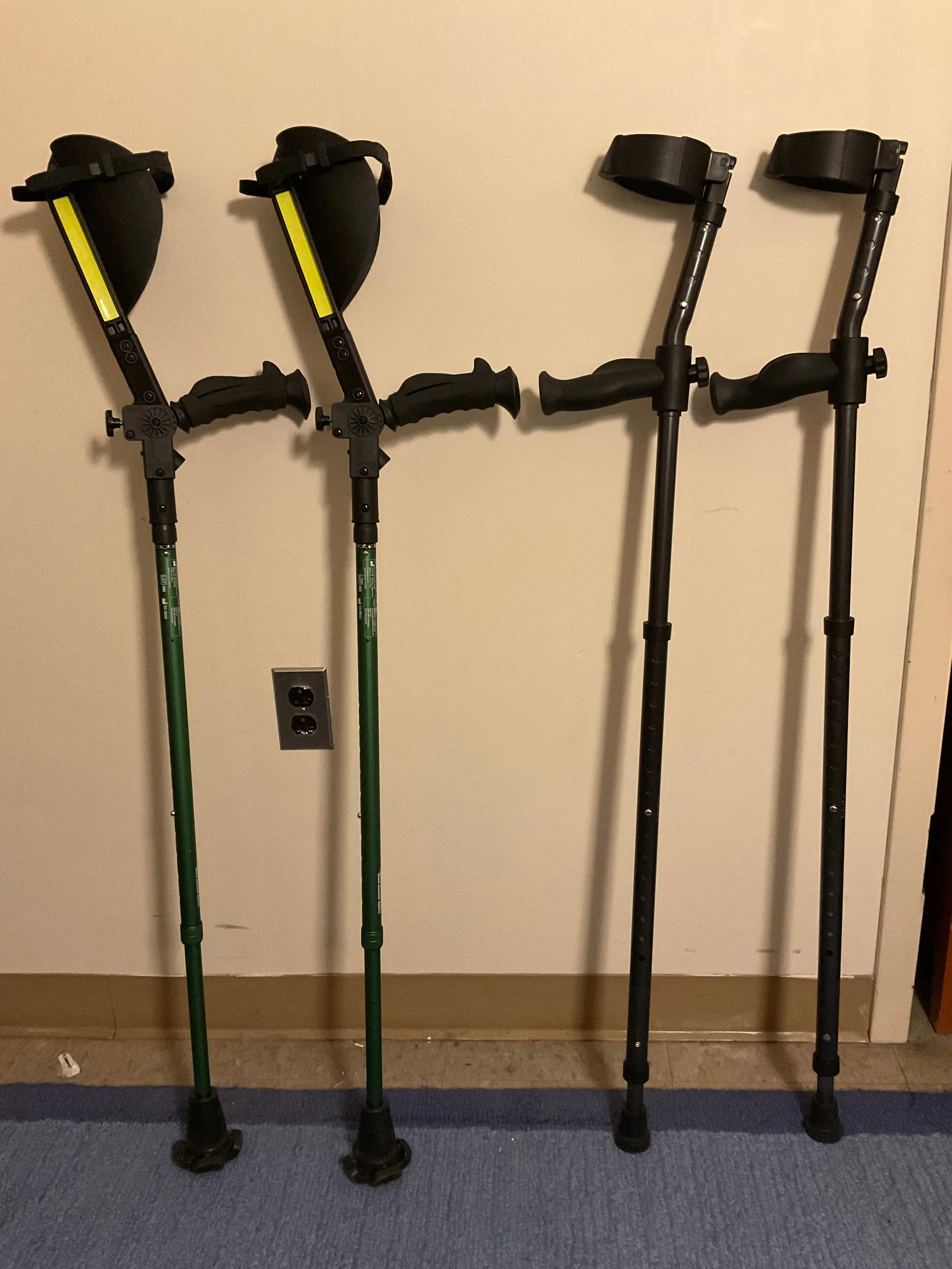
On the left, my Ergoactive crutches in green. On the right, my new refurbed Millennial In-Motion Pros.
How the Millennials Beat the Ergoactives
The most noticeable differences between the Ergoactives and the Millennials are the weight, the cuffs, and the shocks (a.k.a. spring system). When I first picked up the Millennials, they didn’t feel that different to me in terms of weight. I was pretty used to the Ergoactives, though I would notice their weight after a while of walking with them. But after test-driving the Millennials for a few hours, I tried the Ergoactives again, and was stunned at how heavy they felt from the get-go. It was a bit like learning to drive on an old car where you can feel every bump on the road, then trying some new cars with smoother experiences and not really getting it until you drive your old car again and realize how much it hurts your poor butt. The weight difference is huge. It may not seem like 2.9 pounds per arm is a lot, but that’s nearly six pounds you’re lifting up and slamming down with every step with the Ergoactives. The Millennials, at 1.8 pounds each, make you lift 3.6 pounds per step, which feels like dancing on air. When you have to use your hands and they dangle from your arms by the cuffs, the lighter weight means you can reach higher, go hands-free for longer, and not have to worry so much if your crutch bumps into someone as it dangles.
Speaking of dangling, the Millennials dangle so much better than the Ergoactives! The Ergoactives have a full padded forearm cradle with a hard plastic strap, while the Millennials have a traditional hard plastic hinging cuff. The Ergoactives’ strap is what lets them dangle from your arms, but it has less range than the Millennials’ cuff, so the crutches can end up sticking out in front of you when you lift your arm to do something, whereas the Millennials fall pretty vertically thanks to range of the hinge. If you use your crutches with pronated forearms instead of neutral (as if you’re using a rowing machine, palms facing down instead of in), you won’t be able to do that easily with the Ergoactives. Plus, the Ergoactives’ plastic is scratchier and less comfortable than the smooth surface of the Millennials.
The third big difference is the shocks, and I’ve got to say, I wasn’t sold on the Millennials at first when it came to shocks. They felt way too bouncy to me. I could feel and see the posts shifting down and compressing each time I put weight on them, and hear the “schlock” sound as they expanded back up. It felt like overkill. But after my test drive, I came back to the Ergoactives and had a recalibrating moment of, “Whoa, who replaced my springy Ergoactives with such rigid posts?” I’ve gotten used to the bounciness of the Millennials very quickly and now my Ergoactives are the ones that feel too jarring and stiff. Your preference may vary; anecdotally, I’ve heard some people with neurological issues that affect their balance aren’t huge fans of very springy crutches, while others who struggle more with pain love the springiness. I fall into the second category.
How the Ergoactives Beat the Millennials
I must speak some kind words for my beloved Ergoactives, however retired they may be. I currently still soundly prefer the Ergoactives’ grips to those of the Millennials. The Ergoactives have squishy rubber grips that while still advertised as truly ergonomic can be used by either hand. From the instructions in the box, I don’t think the dual handedness was their intention, but I mix them up all the time (because I took off the stickers telling me which one was left and which was right – whoops) and have no hand/wrist pain or discomfort. The Millennials, on the other hand (ha!) have hard plastic grips with a curved ridge that guides your thumb to a proper position. The right crutch’s ridge only works with your right hand, the left with your left. This is annoying for single crutch users who like to alternate which side the crutch is on, as I sometimes do when I need a hand free for an outing. The Millennials also do not allow for you to change the angle of the grip, as far as I can tell, while the Ergobaums offer three choices: 15 degrees up, 0 degrees horizontal, and 15 degrees down. The Millennials are stuck at a downward angle. Anecdotally, I’ve heard that angled down is the way to go for wrist health, so you may not consider this too much of a strike against the Millennials unless the freedom to choose is your biggest priority. As for the material, I currently prefer the squishy rubber of the Ergoactives for its comfort, though it does sweat a bit more than the Millennialsm, so time may change my mind.
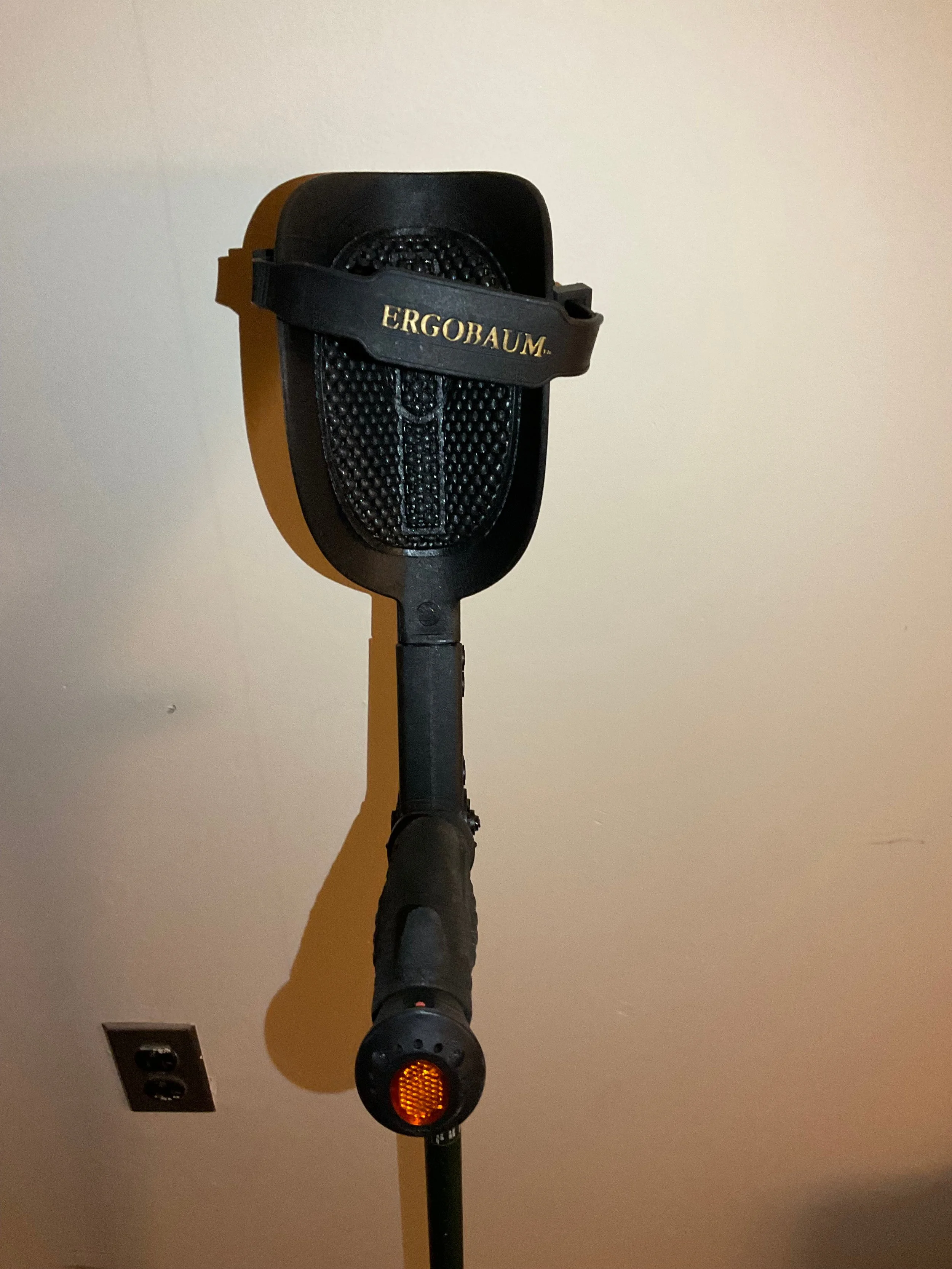
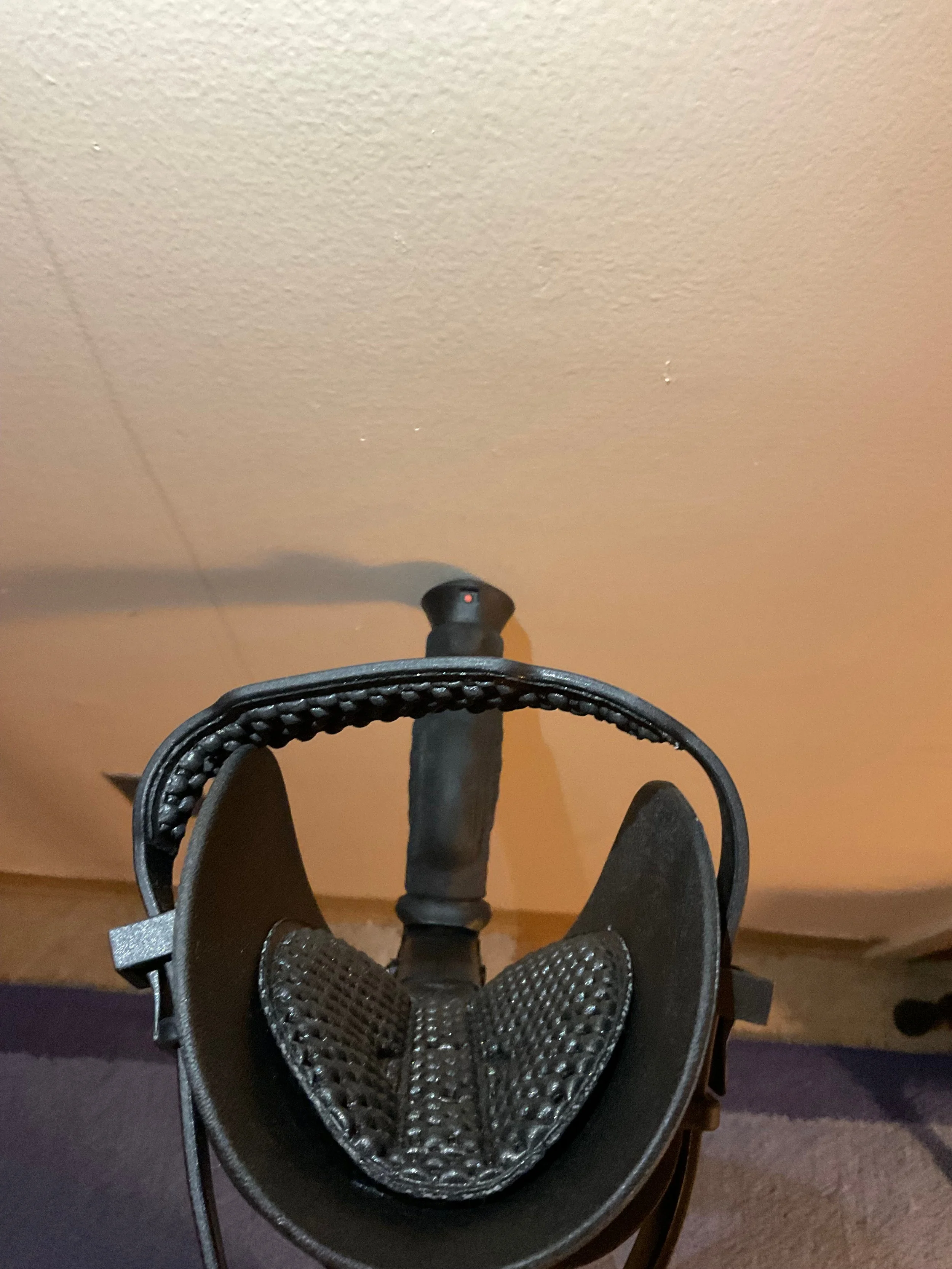
The Ergoactives’ forearm cradle and handgrip.
The Ergoactives advertise themselves as being the “Rolls Royce of Forearm Crutches,” and from what I understand they adopt this label due to their special bonus features. These are, principally, the flashlights/torches, the beepers (“horn”), and the knee rests. The flashlights are the most useful and are a feature I do think other crutch companies should consider incorporating. They’re discreet, accessible via a tiny switch on the back of each crutch, and though I’m not sure exactly how much they contribute to the Ergoactives’ weight, I presume it can’t be that much. Since if my math is right, crutching with two hands leaves you with no hands free, it can be a pain to try and carry a flashlight/torch with you while crutching in the dark. Not everyone has a headlamp, so it’s nice to have built-in flashlights/torch that do a solid job of illuminating the ground in front of you. I have a lot of fun using them on late-night dog walks.
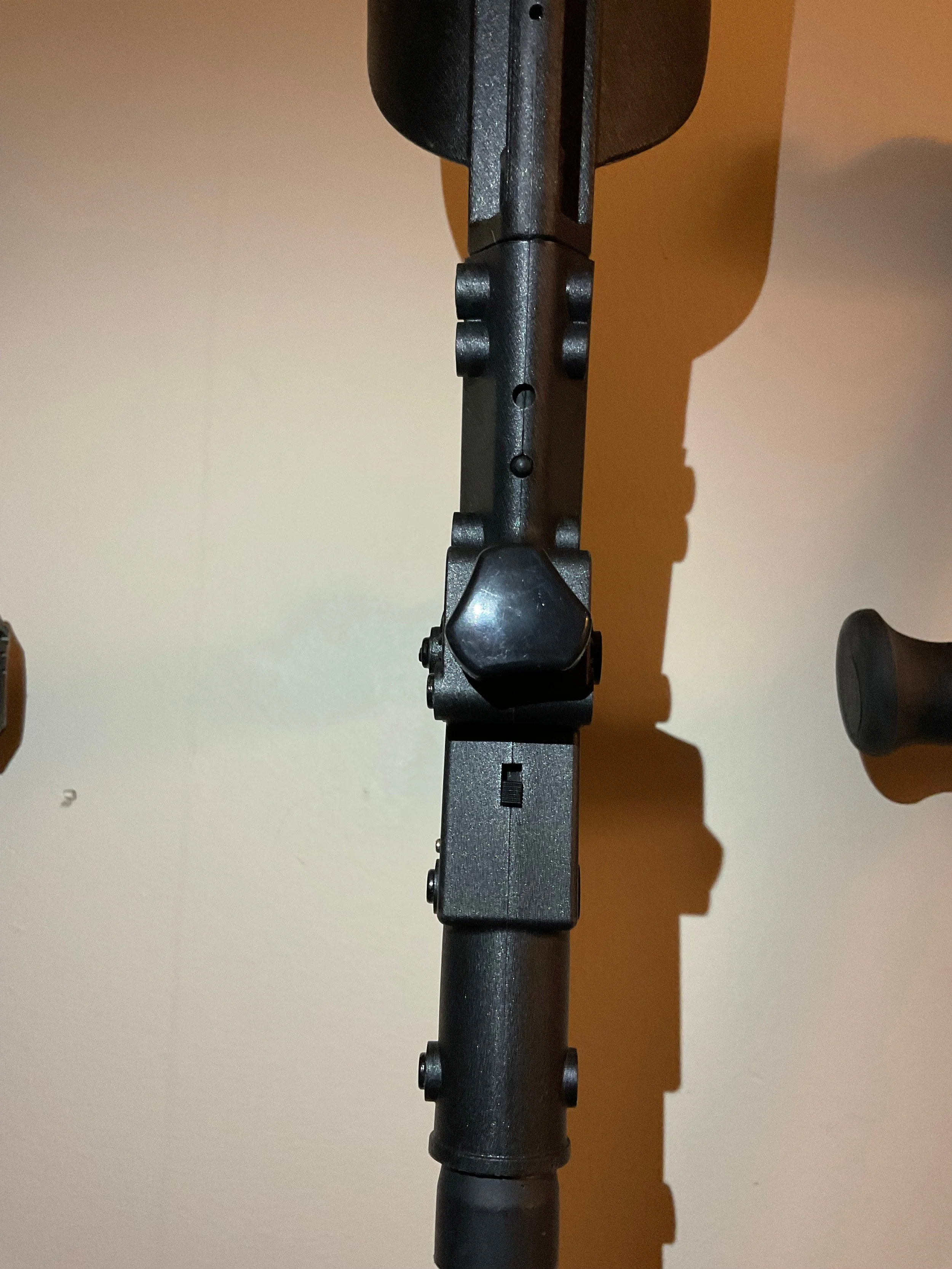
Here’s the tiny switch to turn on the LED light — it’s right under the knob, so still reachable while crutching if you slide your hand down.
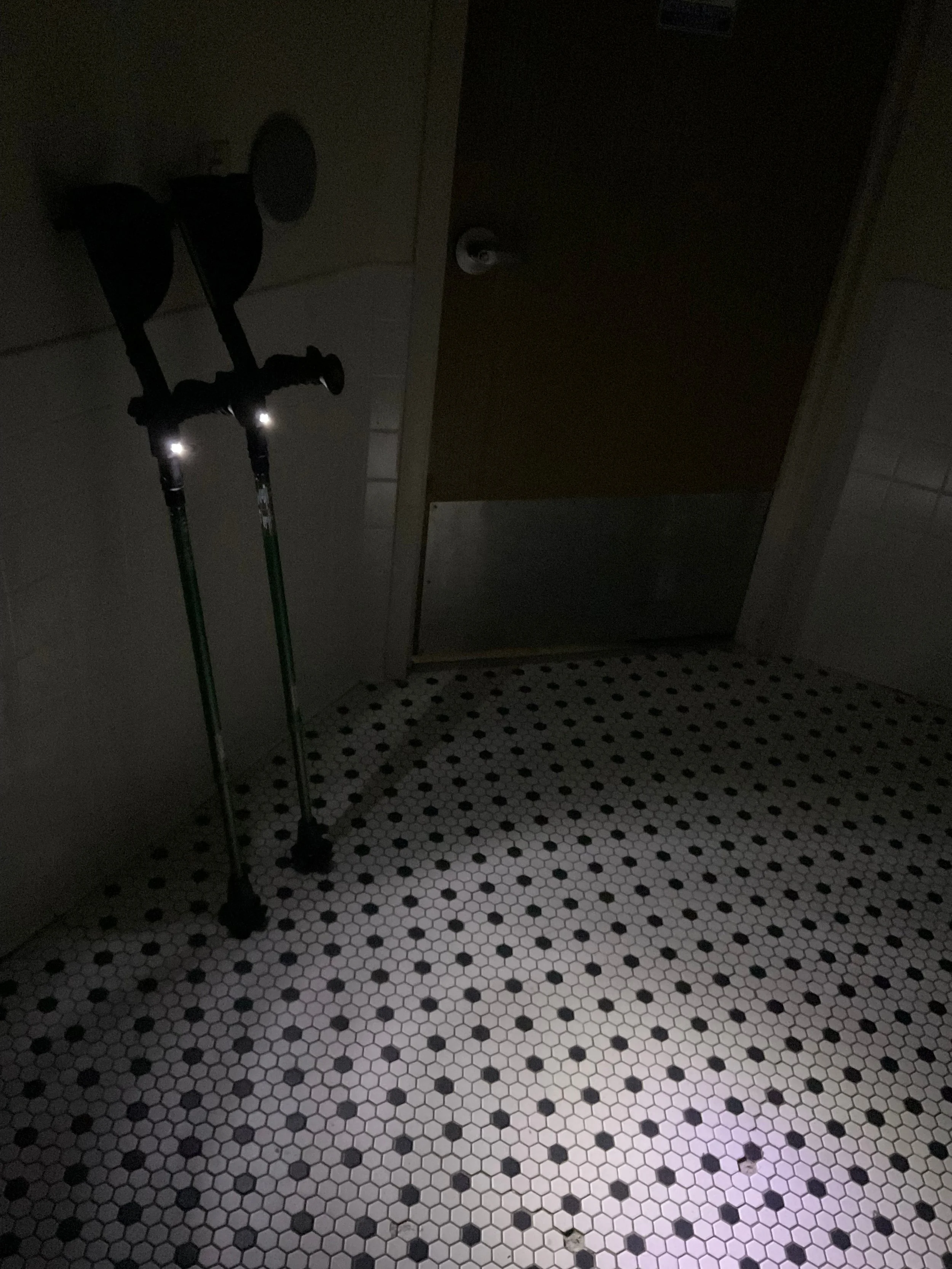
Here’s my best attempt at photographic evidence of the Ergoactives’ LED power, taken in a pitch-black room with no flash. They’re pretty good, lighting up the area in front of you where you will next be placing your crutches and feet.
The beeper horns are another built-in feature, but one I rarely use. Each crutch grip has a tiny little red button you can press with your thumb while crutching that triggers a high-pitched beeping noise that Ergoactives calls a “horn”. I would argue the pitch is such that it doesn’t warrant the title. The beeps are slightly different tones from each other, which from what I understand is purposeful, because if you press them at the same time, the discordant sound is more likely to get people’s attention. That being said, I can’t see myself ever using a crutch horn to get people out of my way in a crowd. They’re just not widely known enough, and since they don’t sound like car horns, I don’t think people in my area would know to move out of the way. I did experiment briefly with training my dog to do different tricks to different patterns of beeps, with the vague idea that if I were to fall and hurt myself and be too far away from him for him to hear my voice, perhaps he’d respond better to the beeps. You may judge me for this idea as you see fit.
As for the third feature included in the Ergoactives – the knee rest – I think very little of it. As soon as I unpacked the crutches, I used a screwdriver and removed them. They’re unsightly, and while they are supposed to stay tucked up against the crutches when not in use, I’d read comments online that mentioned them falling down while crutching and being generally very annoying, so I didn’t want to waste time waiting for that to happen if I wasn’t going to use them. I can imagine they might be of interest to people with problems chiefly in their foot or ankle.
Another nice thing the Ergoactives offer that the Millennials do not is the choice of crutch color. You can get the adult crutches in black, blue, purple, aquamarine, green, gold, grey, white/black, or blue/black at time of writing, or the juniors in black, blue, or pink; mine are green, which I do love. Of course, this is likely not going to be on top of your priority list, unless you’re buying the crutches solely as an accessory (which, if there are people out there doing that, then my opinion is: keep it up! I’d love to see forearm crutches more normalized in public, especially here in the USA where they often play second fiddle to underarm crutches). But despite their lack of color options, the Millennials do win out over the Ergoactives when it comes to aesthetics, in my opinion. Their slim design is attractive and professional, while the Ergoactives have a lot going on that makes them look clunkier and more obtrusive.
Other Insights
I mentioned earlier that my Millennials are refurbished, not new. I chose the refurbished option because it’s USD50 cheaper than a brand new pair and any imperfections are said to be solely cosmetic. Readers, I am thrilled with my choice — I haven’t noticed a single scratch, ding, or smudge. They came out of the box looking spanking new.
Both the Ergoactives and Millennials break down into two parts of similar length. The Ergoactives’ two pieces are connected by an elastic cord, while the Millennial parts are independent of each other. The Millennials can break down further into three pieces if you take out the forearm cuff.
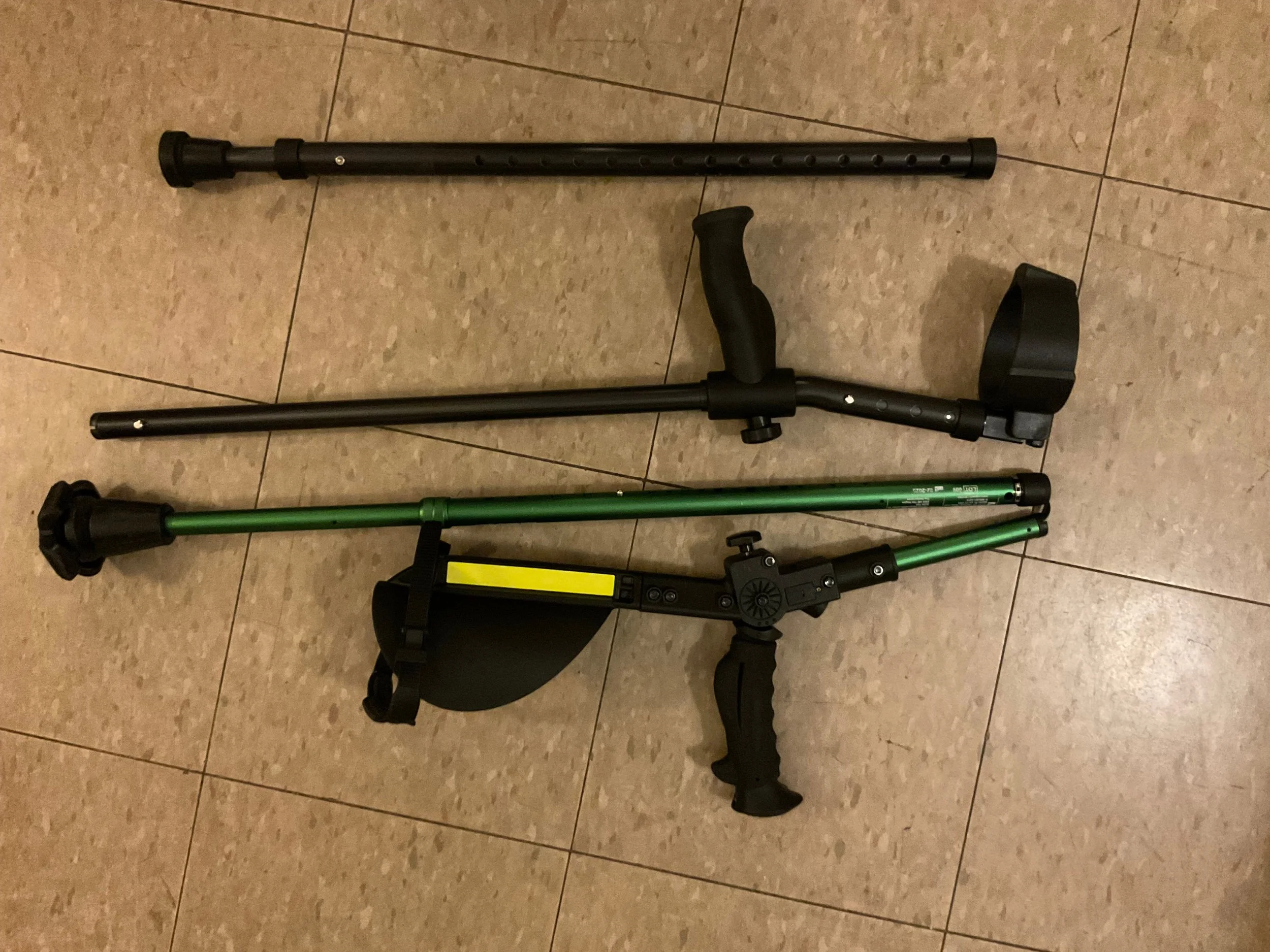
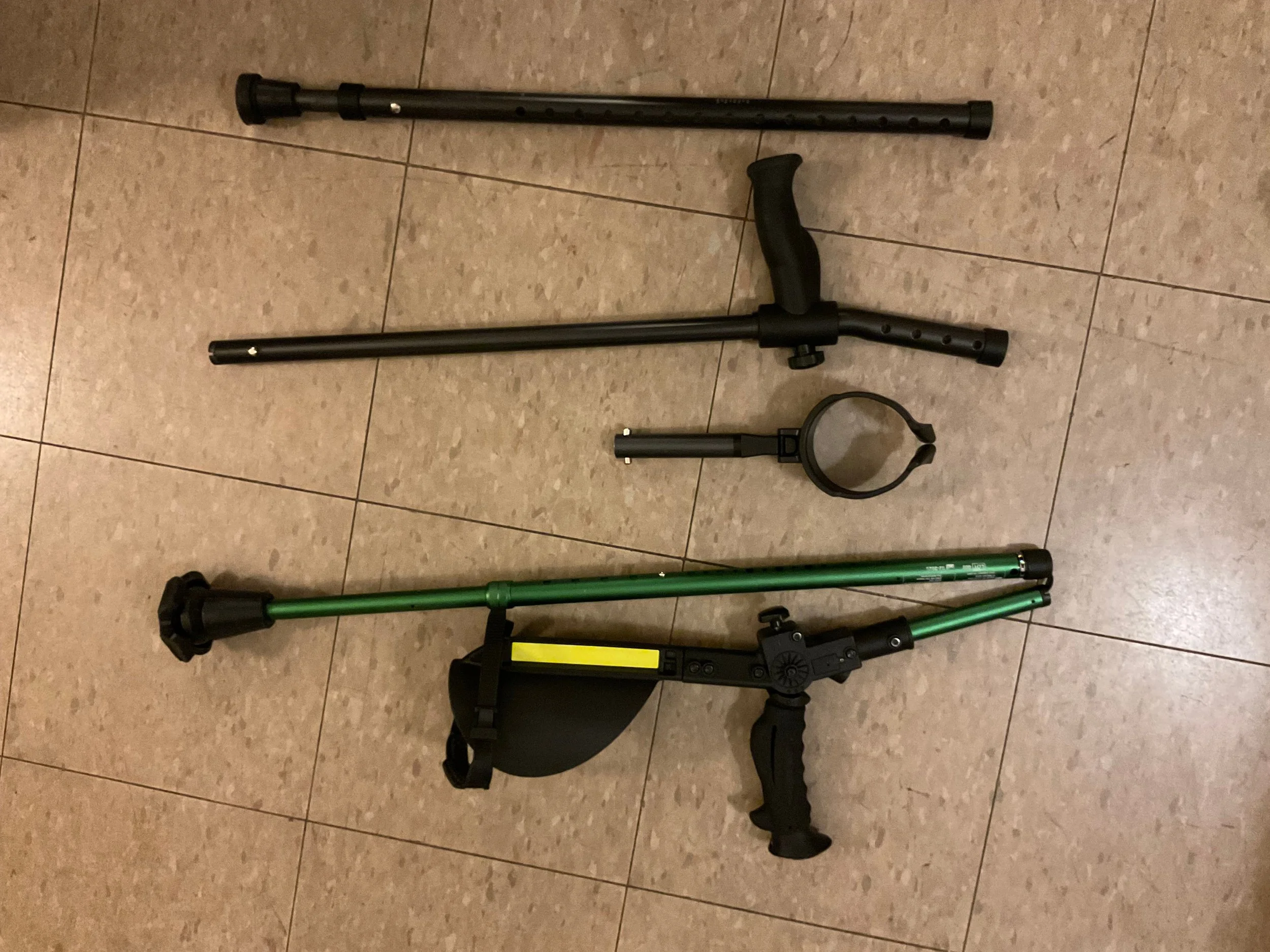
Here they are broken down, first the way you normally would take them apart for, say, traveling; then with the Millennials fully deconstructed.
One final factor: more than my crutches, my daily driver mobility aid is actually my bike. My pain is usually only upon sustained weight-bearing, so a bike allows me to quickly travel long distances at my place of work and not stay on my feet long enough to be in pain. I used to carry a small handheld bike pump around, strapping it into a semicylindrical holder that is bolted to my bike frame. Back when I used my Freebies, I could take one with me by ditching the pump and clicking the crutch into that pump holder, allowing me to bike with two hands, and it was the coolest thing ever (if you want to try this, this is the type of pump holder I’m talking about). But switching to the Ergoactives put an end to that, because while the crutch poles match the diameter of the holder, the foot (their “ErgoCap”) is too bulky and gets in the way of my pedaling. While this could be solved by replacing the ErgoCaps, I didn’t want to spend more money than I already had done to do so. The Millennials’ caps are much smaller than those of the Ergoactives, so I don’t have the problem anymore and can once again carry my crutch while biking with ease!
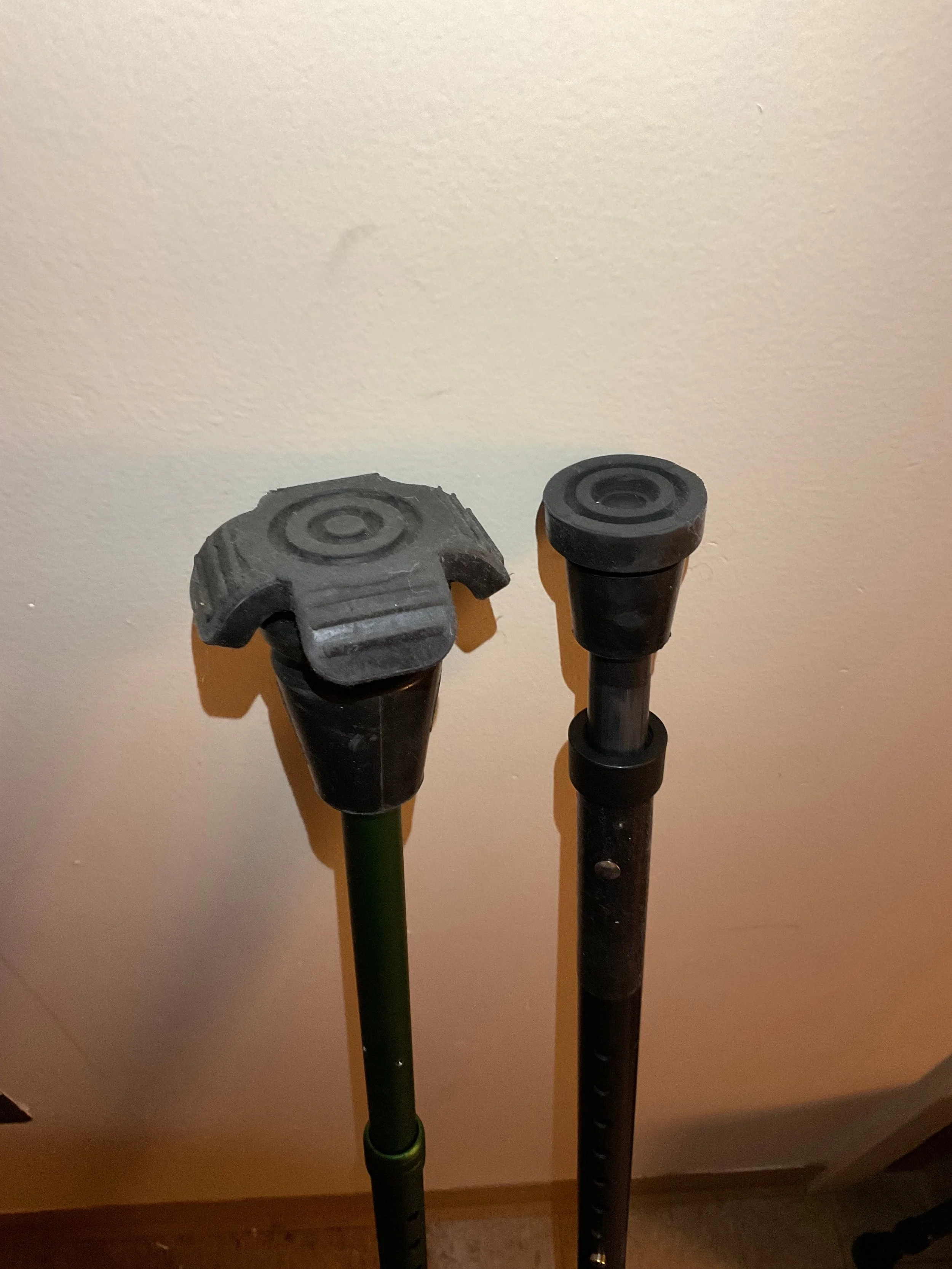
The ErgoCap definitely dwarfs the Millennial cap, but it’s not too noticeable while crutching or if strangers don’t know to look out for it.
Comparison Chart

Conclusions
After using both, I’d recommend the Millennials for most people, due to the weight and price being my two most important factors. People at the very tall side of the height distribution curve and those who keep their forearms pronated while crutching should definitely avoid the Ergoactives, but those who are shorter than 4’2”/1.27m, find the flashlight/torch option attractive, or prefer a larger forearm cradle might find them ideal. While my Millennials have been getting more and more use, the Ergoactives will always have a special place in my heart, since without them, walking and hiking would have remained activities I avoided like the plague.
Wither I crutch, I crutch with joy!
Virginia
To purchase Millennial Medical’s In Motion Pros, use the code “WILD” at checkout for 10% off: https://crutches.com/WILD
To purchase Ergoactives Ergobaum, go to: https://www.ergoactives.com/products/crutches