Learning How to Explore the Outdoors with Chronic Illness & Disabilities
This blog post was originally a webinar for the Montana Library Network. To watch the video instead, go to: https://youtu.be/mLq3oVf_spU
Hello everyone! First, I want to say thank you to Bobbi and the Montana Library Network for inviting me to give this presentation today, and a thank you to Neil Meier, the President of the Hellgate Mineral Society who recommended me when he was doing his talk last year. This is such a cool opportunity to talk about the things I am passionate about so I'm really excited to be here, and I appreciate everyone who is joining us today. Hope you're all having a low pain low symptom day.
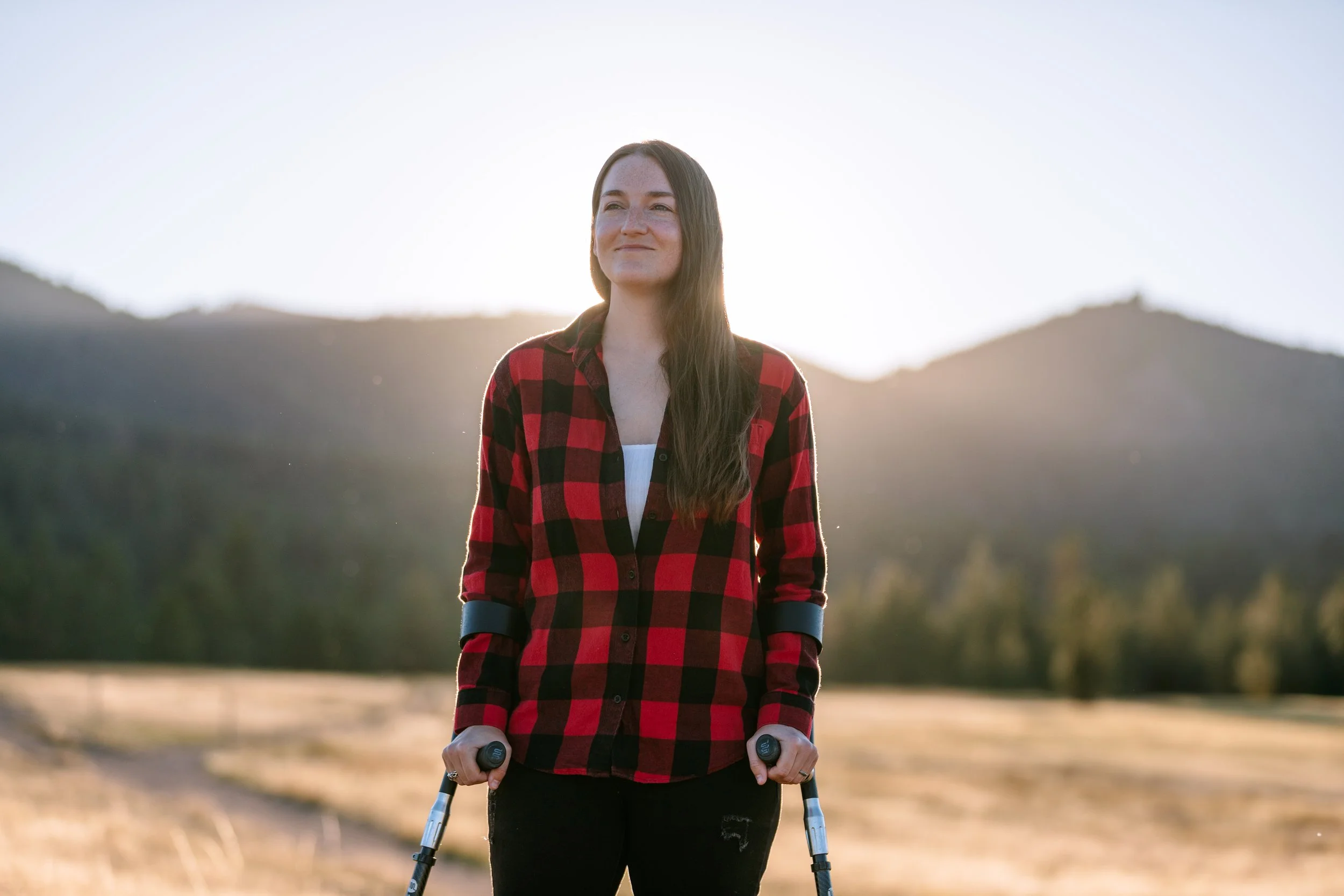
My name is Amy Denton-Luke and I'm the creator of Disabled in the Wild, an Instagram account, YouTube channel, and blog where I talk about exploring the outdoors with chronic illness and disabilities. My primary goal is to encourage other people with chronic illnesses and disabilities to find ways to enjoy the outdoors within their abilities and interests, and I also enjoy helping nondisabled folks challenge their assumptions and learn what it really means to be disabled.
I do a variety of content creation. On Instagram, I like to share pictures, personal experiences and short stories. I'm a writer, so I prefer writing long-form content, so I created the blog to explain my thoughts in detail and my lived experience more thoroughly, for example, “The Challenges and Privileges of my Disability Experience”. I also took on the project of writing accessibility reviews for Missoula's nearby outdoor spaces, after being inspired by Syren Nagakyrie's work for Disabled Hikers. On YouTube, I have turned some of my blog posts into video format, for example, “Tips for Exploring the Outdoors” and “My Must Have List for Outdoor Adventures”. I've also made a few adventure videos to show others how I like to enjoy the outdoors and how I do it with my disabilities.
Through my work with Disabled in the Wild, I've been fortunate enough to get invited to give a guest lecture for the University of Maryland, I was featured in two local magazines last year, and I created a video for an event for Explore Austin, all of which were focused on accessibility in the outdoors. So this is a topic that I not only love sharing with people, but it's one that I think a lot of folks are taking interest in, which is great!
Tonight, I will first share a bit about my background, my story, and how I explore the outdoors with my own disabilities and illnesses, then I'll give some examples of my work and share details from a few of my favorite projects. Then I'll touch on some big picture stuff with myths and misconceptions about disability and the messages I don't want to give, and finally, the goals and takeaways I do want to share with others. I'll also pause for questions between each section so feel free to ask questions as we go.
My Background
I have always had a deep love for the outdoors. I actually grew up in the suburbs of Chicago, but I lived for fishing trips to the nearby forest preserve and exploring the woods with my cousins in Wisconsin. I loved anything that got me outdoors and I was also really interested in rocks and fossils. I had a rock tumbler and a little rock collection. My grandfather was a rockhound and he would give me a few of his rocks every time we went to visit him.
I was 12 years old when I decided I wanted to go to MSU Bozeman for college, and I could not wait to live in the mountains. I made that dream come true when I moved to Bozeman in 2007, and graduated with my Bachelor's degree in Anthropology in 2011. After graduation, I took time off of school to work, but still wanted to maintain some closeness to my interests. So I volunteered at the Museum of the Rockies cataloging a collection of stone tools, and that's also when I went rockhounding for the very first time.
One of my favorite rocks gifted to me by my grandfather was this big Montana agate from the Yellowstone River, or so I thought, and I was determined to find one myself. And I did! After a few trips out, I found my first big Montana agate just east of Billings, and then I found out this is actually a Brazil agate I had accidentally mislabeled.
After that first big find, it quickly became my obsession. I started taking more and more rockhounding trips each year, not just to the Yellowstone River, but all over Montana and even into Idaho and South Dakota. I searched for all kinds of rocks- mostly agates, but also some petrified wood, Jasper, crystals, sunstones, fossils, and sapphires. Every year I got better at rockhounding, and every year my collection and my obsession grew. My collection now weighs 2,280 pounds, I have an entire room in my house dedicated to rocks, plus a few dozen totes stacked in the garage. I love rocks so much I even started hand-embroidering Fairburn agates, and I'm hoping to set up my lapidary shed this year and start learning how to cut and polish them using my grandfather and great uncle’s lapidary equipment. And almost my entire 2,280 pound rock collection was self-collected while I was both chronically ill and disabled.
Illness & Disability
I have not been disabled my whole life, but I have had health issues since birth. Those health issues became much more debilitating at 17 years old, and over the following five years, throughout my time in undergrad, I had 5 laparoscopies and two angioplasties for Median Arcuate Ligament Syndrome and endometriosis. After my last surgery in 2011, I had a few decent low-symptom years. Both illnesses were under control and fairly well managed, and I started to feel more confident in my health, which is when I decided I was ready to go to grad school for archaeology. I was accepted into U of M Missoula, where I planned to study lithics, aka stone tools. We moved to Missoula and I was happily looking forward to this next chapter... and then I got sick again. And it got really bad really fast.
I went from being able to work two jobs 6 days a week, plus rockhounding, volunteering, spending time with friends to being unable to eat or sleep, having severe joint, muscle, and nerve pain 24/7, chronic fatigue, brain fog and cognitive dysfunction, difficulty focusing, reading, and retaining new information, confusion and disorientation, clawing in my hands and difficulty with gripping, swollen lymph nodes, migraines, vertigo, numbness and tingling, and more all within just a few months. And then one Friday afternoon in September of 2015, the right side of my body went numb and tingly. I noticed my right leg was struggling to keep up with me, and within a week, I was using a cane.
I was initially quite determined to stay in school. I even did a month-long field dig in Canada when I was very, very ill and had no business being there. But, despite my best efforts and the support of my wonderful advisor Dr. Anna Prentiss, I had no choice but to drop out in 2016.
I was eventually diagnosed with Chronic Inflammatory Response Syndrome, not a well-known illness yet, but basically, CIRS is caused by a genetic susceptibility and exposure to certain biotoxins. Genes load the gun and exposure pulls the trigger, as they say. Symptom-wise, it mimics MS, fibromyalgia, chronic fatigue syndrome, and others. Aside from a recent relapse, most of my symptoms have disappeared or improved with treatment, and these days my symptoms are primarily chronic pain, fatigue, and cognitive dysfunction, as well as mobility issues. But ten years ago, things were still very much in the "getting worse" phase, especially my legs.
While a cane was enough for me initially, as my condition and legs grew progressively worse, my body really needed more support. This was especially evident when I would attempt to go rockhounding. Even though I was very sick, my desire to be outdoors never wavered- it was my happy place and the thing that kept me going through my illness and treatment. At the time, I could only be outdoors for an hour or two before becoming too sick and in too much pain, and my legs would get so bad that I could barely walk at all. I would be inching my way back to the truck while sobbing from the pain. The cane just wasn't enough anymore and I either needed more support or to never leave my couch again.
So in August of 2017, I bought forearm crutches, and on my 28th birthday, I went for my very first walk with them, and it was one of the happiest days of my life. I was suddenly able to walk so much farther and faster and with so much less pain. It was such a relief after struggling so long with the cane and I was kicking myself for not switching sooner.
The biggest things the crutches help with are fatiguing weakness, which means the farther I walk, the weaker my leg muscles become and the less function and control I have, especially in my right leg. So while I can walk a short distance unassisted, after about 200 feet, my legs will just kind of stop working right. The crutches also help with my chronic nerve and muscle pain by taking pressure and weight off my legs, which makes it less painful both during and after using my legs, with shorter and milder flare-ups. The crutches also give me stability, confidence, endurance, less recovery time, and freedom. I felt like I could do anything.
That first walk with forearm crutches was life-changing and gave me a lot of hope, but I still wondered if it was even possible for someone like me to explore the outdoors. While the crutches were very helpful, my support needs don't begin and end there. I still had a lot to worry about: What if I walked too far? What if my pain level became overwhelming? What if I got hit by fatigue or dizziness? What if I got confused? I needed to know that outdoor recreation was still possible for me, and I really needed to see someone with my disabilities exploring the outdoors.
That's when I started searching online for encouragement and hope. I found one video on YouTube of a man walking on a trail through the woods with forearm crutches, and a couple of pictures on Instagram of a forearm crutch user hiking with a group called Resilient Squad, founded by Edgar and Rosie Rodriquez. It was not long after when Syren Nagakyrie founded Disabled Hikers. All of these people gave me the courage and the permission to try to explore the outdoors and figure out what works best for me.
How I Learned to Explore
Through a lot of trial, error, and flare-ups, I have learned a lot about what works for me in the outdoors, and what works for me obviously won't work for everyone. We all have different needs, different interests, different abilities. I think it's worth acknowledging that I still have a fair amount of mobility, I'm still able to do my favorite pastime, I have access to public lands, a partner willing to join me on adventures, money and equipment to be able to do these things, and I think that makes a big difference, so everyone's journey will look different, of course. But learning how to explore the outdoors with my own illness and disabilities didn't happen for me overnight; it's a process that takes time. And I think that process starts with grief.
On Grief
When you become disabled later in life, you have to go through a period of grief and acceptance, which can honestly take years. You have to let go of the way you used to do things and adjust to this new life and your new limitations. Once upon a time, I could leave my house at the crack of dawn, drive three hours to a rockhounding spot, collect rocks until dusk, and then drive three hours home, and still go to work the next day. I definitely can't do that anymore, and I had to learn to settle for much, much less in terms of where I can go, how much I can do in a day, and how it affects me afterward.
I am not a Hiker
I am not a hiker. That much has become quite obvious to me. It currently takes me about an hour to walk a mile, sometimes more depending on the terrain, and I can only walk about two miles in a day total. If I need to, I can walk a little faster and a little farther, but it's just too difficult and painful, and I don't enjoy the pressure of having to do persistent forward movement, especially with a single destination in mind that I may or may not be able to reach. So, hiking for the sake of hiking is just not a good fit for my abilities.
Rockhounding is the Perfect Fit
However, I have learned that rockhounding is the perfect fit for my abilities, which is what I'd rather be doing anyway. Most of the rockhounding I do involves wandering around on wide-open BLM land, and I'm usually only about half a mile from the truck and road, which means I'm also not far from help if I need it. I not only don’t have to go far, but I also don't have to go fast. I can take my time getting to my rockhounding spot and then wander around slowly at my own pace. And in fact, when you're doing surface collection rockhounding you're already naturally moving slowly because you're carefully scanning the ground for rocks, and if you go too quickly, you might miss what you're looking for, so it's better for me to move slowly anyway.
I Don’t Have to Push Through
When you're chronically ill, you have to push through symptoms at some point or you'll never do anything at all, but there's a difference between pushing slightly outside of symptom tolerance and completely destroying your body. It took me a long time to unlearn this tendency to ignore my body's needs and push myself way too hard, and this is one I still struggle with at times. I'm learning how to let my body lead the way rather than my stubborn determination. It is much more valuable to me now to take good care of my body, listen to what it needs, and go at whatever pace my body wants.
I Can Take Breaks
So I have also learned how to take breaks, as often and as lengthy as I need to. It helps me to manage my symptoms like pain and fatiguing weakness a lot better, which means I can enjoy my time outside more, and possibly spend more time outside as a result. I carry a couple of different lightweight portable chairs with me. Sometimes sitting isn't enough, and I really need to lie down. The fatigue, dizziness, or muscle weakness can overwhelm me quite suddenly, so I have learned to lie down and sometimes take a two-hour nap on the riverbed until I am feeling well enough to either walk back to the truck or just continue with my day.
How to Pack
So those of you who are chronically ill know that anytime we leave the house, we have to bring a lot of stuff. This is especially true when you're outdoors, and you don't have the legs to be making more than one trip to and from the truck, so I have to pack my backpack so that I have everything I could possibly need for the entire day. I always carry two lunches, snacks, two bottles of water, Gatorade, medications, extra clothes, a portable chair, and more. But I can carry a surprising amount of weight on my back, which is what happens after years of rockhounding.
Positives and Benefits
There are positives and benefits to being a disabled rockhound. As a forearm crutch user, I have a built-in advantage: I automatically have four points of contact while crossing rivers, and I always have trekking poles for going uphill and downhill. I have also learned that I am at my most capable on steep hillsides and wading in rivers, which might be surprising to some folks. My whole life involves steadying my muscles and finding balance and strength where it feels like there is none, as well as paying very close attention to my body, so it comes naturally to me. The slow, sustained muscle engagement and hyper-awareness of my body is much easier for me than the hurried and relentless forward movement of hiking.
Each Day is Different
And ultimately, each day is going to be different. There are days when my body will cooperate, and I'll have a great time. There are days when my symptoms are higher, and my body needs more support, but it's still an overall enjoyable day. And then there are days when it doesn't matter what I do, how much I prepare, how slow I go, or how much I rest; sometimes my symptoms will be unbearable, and it's just going to be a crappy day outdoors. That's just life with chronic illness.
A New Outlook
Before I became disabled, I remember trying to hike with a few different groups back in college, and I could never keep up with them. I was very slow. I needed a lot of breaks. The people I went hiking with were not always the most patient and sometimes would leave me behind. I was always getting pressured to push myself beyond my limits, to go faster than I could go, to skip taking breaks, to catch up and keep up, and it made me feel like crap. While I did enjoy hiking, I hated that there was always this expectation to do it quickly, to rush through it, to get to the top to conquer the mountain, to spend five whole minutes enjoying the view, then race back down the trail. That experience has had a major impact on how I view outdoor recreation even today, and perhaps my favorite lesson I have learned... is that I don't have to approach the outdoors that way anymore.
Being disabled has given me a new outlook on exploring the outdoors. It's a much slower, more intimate, and grounded approach to the outdoors, and I have grown to appreciate this new way of being in nature. I love that I can let my body lead the way. I'm not as anxious about what symptoms may arise. I feel safe and at home resting in nature and tending to my body as needed, and I can more fully enjoy where I am in the moment.
I have no interest in fighting my body, conquering a mountain, or being an athlete, or even doing adaptive sports, to be honest. I just want to sit next to the river. I want to drive into the grasslands and wander around for a while. I want to be gentle and go slow; to lean into what my body needs and explore at my own pace and within my own abilities. I want my body to be enough as it is. And I want other disabled people to know that that's an option too.
There was a time when it was so important for me to see examples of other disabled people exploring the outdoors. I needed to know it was still possible for me. I was grateful for the few examples I had, but I wished that there had been more. That's when I realized that I could be that person for others. I could help show people what's possible. So in January 2022, I created Disabled in the Wild and started sharing the kind of content that I needed to see when I was younger, and I knew exactly what it meant to the person on the other side watching it.
Disabled in the Wild Projects
Now I will share a few examples of my favorite Disabled in the Wild projects, starting with Tips for Exploring the Outdoors with Chronic Illness and Disabilities.
Tips for Exploring the Outdoors with Chronic Illness and Disabilities
Tip #1: Preparation and Planning
Before I go anywhere, I try to gather as much information about a place as I can from reviews, maps, and various websites so I can plan my trip accordingly. For example, if people are commenting that the road to the trailhead is super bumpy, I'll bring my nausea medication. Or if I'm going to a park with a walking trail but no benches, then I'll bring my portable stool.
It’s also a good idea to have a backup plan, so that if you drive hours to a location and for some reason it’s closed or not currently accessible due to snow, flooding, or construction, you already have a plan in mind for somewhere else to go. This saves you from having to find a different spot to visit while fighting through brain fog, or simply going home and causing a flare-up over nothing.
I'd also recommend having all the info you need about the site available offline, including offline maps, notes, or screenshots of the info, so it’s all in one place, and you don’t have to try to remember what you read or find it again when you might not have cell service.
Tip #2: You Do Not Have to Conquer a Mountain
It can be really difficult for people who became disabled later in life to accept that they can no longer do what they used to. And for some people, this will stop them from pursuing outdoor recreation altogether.
When we return to the outdoors with our new limitations, we often have the same expectations of our bodies that we did before becoming sick or disabled, and we make comparisons with how we used to do things, which makes the adjustment even more difficult. It's really important to first take the time to process your grief, and then when you're ready, try to start over. Meet your body where it is right now. Get to know this new you and your new body. Learn a new way of interacting with nature and existing in the outdoors. Be open to trying new activities or trying your old activities in new ways.
In addition to letting go of past expectations, we also need to unlearn how we've been conditioned to approach the outdoors. It doesn’t have to be a ten-mile hike or nothing; it’s possible to enjoy the outdoors without conquering a mountain or getting an adrenaline rush. The idea that we have to go quickly and show off our strength and power and conquer is very much a part of our capitalist, colonial worldview, but it doesn't have to be. We don't have to rush through it, conquer it, show off, or be in competition with others. We can just be here to enjoy it.
Spending time in nature can look however you want it to look. It can be simple things like practicing nature photography at a park, birdwatching at a wildlife refuge, or sitting in your backyard. It’s okay to slow down, be gentle with your body, and just enjoy being in nature.
Tip #3: Use the Damn Mobility Aid
A lot of folks really struggle to start using mobility aids. People may feel embarrassed, self-conscious, or think their condition isn’t bad enough. But you don't need to have a total loss of function to justify using a mobility aid. If you think a cane, rollator, or trekking poles can help you reduce symptoms like pain or fatigue, or increase stability, balance, endurance, or confidence, and that’s all it takes for you to get outside and enjoy the outdoors, then it’s worth it. Increasing your quality of life is a completely valid reason to use one.
I wish people knew that mobility aids are not a negative thing. Using an aid is not somehow giving up on yourself or giving in to disability. Mobility aids exist to support our bodies the way they need to be supported and help us continue living our lives the way we want to live. Mobility aids can make it possible to go to certain places or do certain activities. That's why so many people view their aids as freedom. I, for one, couldn't do any of the things I do outdoors or indoors if it weren’t for my crutches. They are a wonderful, positive addition to my life.
Tip #4: Rest and Take Breaks
Taking breaks periodically, for example, sitting down to rest for 5 to 10 minutes every hour, can really help manage symptoms to make it a more enjoyable day, and maybe even make it an easier recovery in the days afterward, too. The great thing about taking breaks is that it gives you time to really take in the view, enjoy the scenery, and truly experience a place rather than just passing through.
I'll never forget the first time I talked about taking breaks on Instagram. Someone commented that she struggled with feeling symptoms coming on as she was hiking, and it would scare her so much that she would rush off the trail and back to the car as fast as she could before the symptoms could get worse- and it had never occurred to her to just sit down on the trail, rest, and pace herself.
Rest is something that a lot of us struggle with, myself included. So many chronically ill people are ambitious overachievers who don't know how to rest or quit, and it doesn't help that we live in a world that tells us to ignore our bodies and push through symptoms at any and all costs, as if hurting your body for the sake of doing the thing is somehow worthy of celebration and praise. In my opinion, the hard part is not necessarily pushing through or trying to do more; the hard part is slowing down, taking breaks, and listening to what our bodies need. ‘Pushing through' is not the only strength we can carry. Listening & supporting, softness & gentleness, resting & pacing are all strengths too.
The reason we spend time outdoors is to connect with nature, enjoy the views and sounds, be in the moment, and admire the beautiful world we live in. When we recognize that simply enjoying the outdoors is the goal, it's easier to let our bodies lead the way, to be mindful of our symptoms and know when our bodies need tending to, when it's time to rest and when it's time to go home. Because if the goal is to enjoy ourselves outdoors, then we must also enjoy-or at least tolerate- being in our bodies while we're out there.
Tip #5: Recovery
It’s pretty common for people with chronic illnesses to have flare-ups after doing- well, anything. So, I think it's important to go into the trip planning for the inevitable flare-up rather than hoping it won't happen. Just expect it, be prepared to take some time to let your body heal, and plan for a few days of rest and recovery. Chores and to-do lists can wait; just be extra gentle with yourself and take good care of you.
So, our adventures may look different than they used to, but if we do a little extra planning and recovery, choose the right activities and adaptive equipment, and take it easy on our bodies, we can still enjoy being in nature.
Must Have List for Outdoor Adventures
Next up is my Must Have List for Outdoor Adventures. Everyone’s must-haves will be different, of course. It really depends on the location you're in, the terrain, the activities you’re doing, plus your particular illnesses, disabilities, and abilities. So, I'll give a few quick examples of the special features and requirements that I have to think about when choosing outdoor gear, and maybe it will help you think about your own list.
I have two lightweight, compact, portable chairs that I bring depending on what activity I’m doing- one chair for longer breaks in one spot and a stool for quick breaks while I'm walking. They're both quick and easy to set up and put away. My backpack has to be large enough to fit not only all my gear for the entire day, but also 25 pounds of rocks. Plus, as a forearm crutch user, my backpack needs to be narrow so I'm not bashing my elbows into the pack as I'm walking.
My boots have to be super lightweight and non-bulky, so I don't trip over my own feet. The crutches I use are specifically designed for hikers- they're lightweight, with ergonomic grips and good shocks that are located higher up on the crutch so they don't get clogged with dirt or rocks. Because I use my crutches for weight-bearing, I wear padded gloves to protect my hands; otherwise, you can rip your skin off when walking long distances. Ask me how I know.
As a rockhound, my hands are constantly filthy and covered in dirt, algae, and likely cow poop, so I bring wipes and hand sanitizer to clean my hands before eating and taking meds. My doctor says I'm not allowed to get any more bug bites, so I need a lot of bug spray and a tick-bite kit. Basic survival gear in case I get stranded somewhere because l run out of legs again.
Lastly, pro-tip for anyone with a vulva and an overactive bladder, especially. If you don't like packing out used toilet paper, but you also know drip-drying isn't quite enough, you can wear a small cotton pad to absorb any excess moisture after squatting in the bushes.
If you're interested in hearing my entire list of must-have outdoor gear, check it out on YouTube or my blog. And while you're on my website, head over to the reviews tab to check out my reviews....
Reviews
I really wanted to do something to help my local disabled community, so one of the biggest projects I took on was writing reviews for outdoor spaces near the Missoula area, including state parks, historic sites, and wildlife refuges. I reviewed 23 outdoor spaces total, which included detailed accessibility information, site descriptions, and photos of the paths, facilities, and views.
I was inspired to do this project by Syren Nagakyrie’s work for Disabled Hikers. Syren started writing detailed hiking trail descriptions in 2018 after finding out the hard way that a lot of hiking trail guides just didn't have the information they needed to determine if a trail was within their ability to hike safely. They started by sharing this information on their website, and eventually published their first book for Oregon and Washington, and then one for Northern California.
I remember wishing there had been something like that available when I first moved to Missoula in 2015. I had a hard time figuring out where to go when I first got here because I was new to the area, but I was also newly disabled and still learning how to navigate that. When I did find a place I wanted to try to visit, similar to Syren, I often had a hard time finding the information online that I needed to decide if it was going to be accessible for me, as well as worth the flare-up afterward. And I, too, had to learn the hard way that sometimes the information I found was not totally accurate. Before we went anywhere, it would have been helpful to know things like: How long is the walk? What is the path like? Are there actually benches? Does it have a pretty view? And I realized the information that would have helped me in 2015 would also be helpful for others in 2022, so I went out to collect that information to share with others.
You can find those reviews on my website or on Google reviews. I also have a blog post called "Why I’m Writing Reviews for Local Outdoor Spaces” if you'd like to read more about some of the accessibility issues I ran into. Next, let's talk about what accessibility in the outdoors even means.
Accessibility in the Outdoors
Accessibility in the outdoors is something that has probably come up the most through my work. I think people are becoming more aware of inclusivity and equity, and they want to know what that means and what it looks like for outdoor recreation. Usually when I say the words "accessibility in the outdoors", people think about a wheelchair user and a paved path, and that’s pretty much it. But just like disabled doesn't solely mean wheelchair user, accessibility doesn't solely or necessarily mean a paved path.
Let's start with some disability basics. Disability just means a person struggles with one or more daily functions. There are many types of disabilities that affect different parts of the body and different daily functions, with varying degrees, shades of gray, strengths and weaknesses, good days and bad. Disability is not solely people who use mobility aids, and, in fact, about 80-90% of disabled people do not have a visible or apparent disability- meaning that for the majority of disabled people, you can’t tell they’re disabled just by looking at them. For example, some folks are deaf or blind, have heart and respiratory conditions, or neurological, musculoskeletal, and autoimmune disorders. The term disabled covers a lot of people with a big range of support needs.
Each disability and every disabled person is different, so their access needs are going to be different as well. So because accessibility means different things to people with different disabilities, we can't simply say an outdoor space is 100 accessible or inaccessible, bc there's too much complexity and nuance to make that determination for other people. That's why it's important for a variety of accessibility information to be available so each person can decide for themselves if a site is accessible to them.
So, what are some examples of accessibility in outdoor spaces?
Parking
For parking, is there accessible parking? Is there van-accessible parking? Keep in mind that some people require that extra protected space to get in and out of their vehicle. Also, is there a ramp and a clear pathway from the parking lot to the entrance?
Restrooms
Are there restrooms? Are they ADA accessible? Are there steps or stairs to get to the bathroom? Are there restrooms farther into the site or just at the parking lot? That can make a big difference for folks with bladder and bowel conditions.
Pathways
What is the material of the path? It does not have to be paved for it to be accessible, just a firm, mostly flat surface. And in fact, paved paths don’t work for every disabled person- myself, for example. I suffer from severe nerve pain in my legs, so concrete and asphalt are actually more painful and difficult for me to walk on. My preference would be something like finely crushed gravel, which is also wheelchair friendly and blends well with nature. Other types of path material include chunky gravel, boardwalks, natural dirt paths, and more.
Next, how wide are the paths? Are there bumps and holes, or is it fairly even? Are there obstacles like tree roots and rocks, rough transitions, or other tripping hazards? Lifting your feet can be very difficult and physically tiring for some folks, so having a lot of obstacles can actually change the difficulty level of the trail. Are there steps and stairs? Are there steep hills? How far is the walk from the parking lot to the point of interest?
Benches
Are there benches? How many and how far apart are they? Do the benches have back support? This would be very helpful for people with fibromyalgia or chronic fatigue syndrome where pacing is especially important.
Signage
Are the trails well marked? Are there signs that clearly point where to go, especially at forks in the trail? This one is important both for people with low vision and people with cognitive dysfunction.
Miscellaneous
There are other little things like strong smells, loud noises, big crowds, or signs warning of toxic algae.
I also like to share information about views and activities like wildlife viewing, for example, so people can decide if a site is worth visiting.
While I wish I could fix accessibility issues, for now, all I can do is give people the information they need to find the outdoor spaces that are a good fit for them. Because without detailed and accurate site information, you can't really know if a site will be accessible for you until you get there. And it can be so frustrating when you find a place you want to visit, drive two hours, and you show up to find the alleged "ADA accessible" state Park doesn’t even have a trail, or the nature trail with "plenty of benches" doesn't have a single bench for the first half a mile, or the entrance to the wheelchair accessible path at a wildlife refuge was washed out by spring flooding years ago and is no longer accessible, or there’s a single narrow footbridge you didn’t know about that prevents you from reaching the wildlife viewing blind. So you either waste your time and trigger a flare for nothing or risk injuring yourself on a potentially unsafe trail, but also... It just sucks to feel so unwelcome and excluded in outdoor spaces that are built for everyone else.
I would like to emphasize that I'm not advocating for paving over all outdoor spaces; I know sometimes people worry that's what I'm saying. And I don't expect 20-mile hiking trails deep in the mountains to have perfectly flat paths and benches every 200 feet. But I do believe our state parks, historical sites, certain areas of wildlife refuges and national parks should be as accessible to as many people as possible. These are public outdoor spaces that are intended for use by the general public, so disabled people should have equal and equitable access to them.
In the future, it would be great to have improved accessibility and a consistent standard in how public outdoor spaces are built and fixed moving forward. The biggest barrier to this is, of course, money and budgeting, plus maintenance. I believe everyone should advocate for outdoor accessibility because accessibility benefits everyone. Any one of us can become disabled or more disabled at any time, and we will all eventually become disabled if we live long enough. But even if we are not disabled ourselves, we all know or care for someone who would benefit from increased accessibility. If not disabled loved ones, then older folks whose mobility and fitness is shifting with age, or families with small kids. Plus, nondisabled people enjoy accessible features too- they use benches, and signs, enjoy larger bathroom stalls, and the convenience of accessible picnic sites.
In a state that places so much value on outdoor recreation, I want all Montanans to enjoy our beautiful outdoors, including disabled Montanans. I always like to say that it’s not necessarily our disabilities keeping us from outdoor spaces, but the lack of accessibility. Because when those access needs are met, we can enjoy the outdoors like everyone else. When we make outdoor spaces accessible, we welcome everyone to enjoy them. When we include not just the bare minimum like accessible parking and bathrooms, but also accessible viewing platforms, fishing platforms, campsites, or adaptive equipment rentals, we show disabled people that they belong here too.
Myths and Misconceptions
We have all grown up in a culture that is inherently ableist; it is simply ingrained in our worldview. And that underlying ableism becomes quite obvious when we look at the intersection of disability and the outdoors, so this is a good opportunity to address those biases. We often don't even realize that we hold these implicit biases until we take a deeper look and really examine our assumptions, and this is true of any bias, like racism, sexism, and transphobia. As I go through these examples, please know we have likely all believed these myths and misconceptions at some point, myself included, so we are all in the same ableist boat and in the process of learning and unlearning together.
Tragedy, Sunshine, and Rainbows
Let's start with the most common belief that people hold: that disability is a tragedy, a fate worse than death, and not a life worth living. This is a pretty extreme view, and absurd and simply not true. Obviously, each situation is different, but, in general, yes, we have our challenges, and it can be a very difficult life at times, but that doesn't mean our lives can't still be meaningful and fulfilling. We can still have careers, families, relationships, hobbies, goals, and dreams. We adapt, we adjust, and we find new ways of doing things. Life goes on after disability.
In response to this disability as tragedy myth, some folks will overcompensate and head into the realm of toxic positivity, where being disabled is always wonderful and a blessing, and never bad, which is also extreme and absurd and simply not true. It might sound like that's a nicer view of disability, but what it does is erase the very real challenges that people with disabilities do face, and it shames the disabled people who are struggling and aren't happy 24/7. That's not a realistic expectation of anybody, including disabled people, nor is it a realistic perception of what disability is.
One of my goals in creating Disabled in the Wild was to fight back against the idea that being disabled is not a life worth living, especially after witnessing how apathetic people were toward disabled lives during the pandemic. I try to be very cautious not to overcorrect and mistakenly give the impression that being disabled in the outdoors is all unicorns and rainbows. I strive to find a balance in my messaging to others and share some of the bad along with the good. Because the truth is that while I love exploring the outdoors, it's not without its frustrations. I never want to pretend like this doesn’t have bad days or consequences or that it's somehow magically wonderful at all times.
Sometimes my pain level is so high that I feel like I'm going to throw up, or I'm just sitting there on the riverbed, sobbing from the pain, waiting for my next dose of pain support medication. Sometimes I'm thigh-deep in the middle of the river when I'm suddenly struck with dizziness and the unmistakable feeling that I'm about to pass out. Sometimes fatigue hits so hard that I can't keep my eyes open, and I have to take a break or nap during the best lighting of the day. Sometimes I wish I didn't have to deal with my limitations; I don't want to stop and take yet another break. I just want to keep doing what I'm doing, so I ignore my body and stubborn my way through until I'm completely miserable and having no fun at all, and the two weeks it takes me to recover from a trip don't really seem worth it. That happens too.
So I'm not saying it's all sunshine and rainbows because it's not, or that I never get frustrated with my limits because I absolutely do. Or that my disabilities never get me down. Of course they do. For any chronically ill and disabled people watching, please know that I'm not over here in a perpetual state of bliss with zero symptoms, and you're not doing something wrong if you're not having a good time every time you go outside. That's perfectly normal. It's not always fun and happy times outdoors.
And the truth is that it's not always safe. I've nearly passed out in the middle of a river before, and I have run out of legs before. There was also one time when I got confused and disoriented when I was rockhounding alone- and the thing about being confused is you don’t know that you’re confused at the time. And while I had done a lot of the right things that day, like heading back to the truck early and paying close attention to my surroundings, I still accidentally made a wrong turn and didn't realize it until much later. And then my legs stopped working, I didn't have cell service to call for help, and it was 4 pm. I had no choice but to, at times, literally crawl my way out of the situation. When I was able to walk, I kept falling because my knees just kept buckling, and it took everything I had in me to get out of there before sunset. The outcome could have been much worse.
Sometimes it doesn't matter how careful you are, shit happens when you have unpredictable symptoms. So please be careful, take extra precautions, and think realistically about both your abilities and disabilities and what is safe for you to do. My message is not about just ignoring the reality of your body, disabilities, or symptoms, and doing whatever the heck you want. It's about figuring out what actually works for you and your body, finding that balance and the intersection between your disabilities, strengths, and your interests. So please take good care of yourselves out there.
Supercrips and the Overcoming Myth
Next, we'll talk about what I call the “overcoming myth”. When disabled people recreate in the outdoors, or really do any activity, we're often praised specifically for "overcoming our disabilities". That's always the word used: overcoming. But what does it mean to overcome a disability? When I'm hiking with my forearm crutches in the mountains, am I suddenly no longer disabled? I'm still exploring the outdoors within my abilities and my limitations. My disabled body still dictates how much I can do: how far I can walk, how fast I can walk, how often I take breaks, which activities I do, what I can do in the days following. So what exactly is it that people think I'm overcoming?
It's not possible to magically overcome a disability. There seems to be this misconception that somehow, through sheer willpower and positive thinking, I am pushing through my disabilities and not allowing them to hold me back from the things I want to do. But that's a misunderstanding of what's happening. I'm still physically disabled, and I'm not doing these things in spite of my disabilities; I'm very much working with them. Just like anybody else, I can't do anything my body isn't capable of doing. I haven't overcome my disabilities; I've simply adapted to them.
Similar to the overcoming myth is the SuperCrip trope, where a disabled person is perceived or portrayed as having the extraordinary superpower ability to do everything a non disabled person does and more, and their disability somehow doesn't really affect them. It's a common trope and stereotype in media. It sets up unrealistic expectations for disabled people, and it perpetuates a view that if disabled people just tried hard enough or thought positively enough, they too would "overcome" their disabilities. This myth also suggests that disabled people are only valid or worthy of praise if they don't "let their disability hold them back" and have zero limitations. We are only perceived to have value when we distance ourselves from our disabilities and have closer proximity to being non-disabled.
One example of Supercrips as it relates to the outdoors is the disabled speakers at outdoor events, who are usually someone who was an extreme sports enthusiast, who had an accident or injury, and then went back to extreme sports but now do it with their disability. Their experience is, of course, valid, and they deserve to tell their stories, too; however, I don't want that to be the only story and the only message told about being disabled in the outdoors. I don't want disabled people to think that the only way they can enjoy the outdoors or be acceptable or have value as a disabled person is to "overcome" their disability and be a SuperCrip. And I don't want nondisabled folks to think that if a disabled person is not achieving the same incredible feat, it's because they just aren't trying hard enough or thinking positively enough.
This is why I find it so important to show through my work not just that I am exploring the outdoors but sharing how I am doing it: how my disabilities affect me, how I accommodate them and adapt, how I continue to work with my body, and that I'm still disabled while I'm doing these things. We do not need to somehow magically do anything and everything a non disabled person does, in the way that a nondisabled person does it. I believe that the disabled person who goes for a stroll at the park to watch the birds is just as valid as the disabled adrenaline seeker. You don't have to defy all odds and do something incredible; it's okay to just live your life. You do not have to be exceptional to be valued.
On Pity, Praise, and Inspiration
“Inspiration Porn” is something I'm sure everyone has seen online before; it's usually in the form of a story or a meme. For example, a picture of a person with a prosthetic leg working out with text that says "What's your excuse?" Or my personal favorite: "the only disability in life is a bad attitude", which makes me laugh every time I see it. Another common example is a news story about a nondisabled student asking a classmate with Down syndrome to prom. Inspiration Porn serves to make nondisabled people feel good or inspired by using people with disabilities as objects of inspiration, often at the expense of their humanity. It is by definition objectifying and dehumanizing.
The term “Inspiration Porn” was coined by disability activist Stella Young. She has a 10-minute TED Talk on YouTube that I highly recommend watching. She talks about how we've been lied to, we've been told disability is a bad thing- capital b capital t "Bad Thing", so disabled people are viewed as exceptional simply for living with a disability, and nondisabled people should feel better about their life, because as bad as you have it, well, at least you're not disabled.
We tend to see disability through this lens that carries a lot of baggage (hint: it's ableism). Instead of understanding that being disabled simply means you struggle with one or more daily activities, we automatically and without realizing it, smuggle in the notion that disability is the bad thing, a life with no value, and disabled people are sad, miserable, and incapable of doing anything at all. Inspiration corn perpetuates and reinforces those beliefs.
One of my concerns from the start of Disabled in the Wild was that my pictures would be taken and used as Inspiration Porn. For example, a picture of me with my forearm crutches with the text, "What's your excuse?" I would never want my pictures and my work to be used as a weapon to shame other people. Just because walking around outdoors is within my ability doesn't mean it's within everyone else's ability. It's simply that my disability doesn't prevent me from doing what I do outdoors. As Stella Young says, we are all using our bodies to their capacity, whether we are disabled or not.
While I haven't been turned into Inspiration Porn yet, I have been told, ""If you can do this, nobody else has any excuse not to". I've also been told, "I'm glad you allow yourself this enjoyment rather than pity". I randomly get comments like, "keep your chin up" "stay positive" "everything will be okay". And here is where that baggage I mentioned becomes quite obvious- through the language we use and the giant leaps we make. The only association most people have with mobility aids and disability is sadness and tragedy; therefore, even in a neutral or positive context, people feel the need to offer me comfort or praise me for not wallowing in pity.
Along these same lines of pity and praise, there's another type of Inspiration Porn that happens in real life, where disabled people who are simply going about their day are told they are inspirational for doing something ordinary, such as a wheelchair user shopping for groceries. This may not sound terrible at first, but it is infantilizing to be given excessive praise for doing something you are perfectly capable of doing. It would be no different than telling someone who is wearing eyeglasses they're inspiring for reading the menu at a restaurant.
This isn't to say you can never be inspired by disabled people or offer praise. It's okay to be impressed and amazed by disabled people when it's appropriate. But there's a difference between being "inspired" by a wheelchair user who is shopping for groceries and being inspired by the folks who publish a book, have a successful career in a difficult field, master a hobby, or become professional athletes. Celebrate disabled folks for our achievements, talent, and hard work just like anybody else, not simply for our disabilities. If you're ever struggling to figure out where that line is, a question I like to ask myself is: would I be offering praise to a non disabled person for doing the same thing? What exactly is it that I'm praising? And is it an appropriate and measured amount of praise, or is it infantilizing, objectifying, and dehumanizing?
As for me, the people I want to inspire most are disabled people. I want to inspire them to work with their illness and/or disability and find a way to enjoy the outdoors. If nondisabled folks find me inspiring, what I hope they are inspired by is my adaptability, my determination, my love for the outdoors, my approach to the outdoors, my desire to help others, or my writing. If I'm praised for something, I want it to be not because of my disabilities and not in spite of my disabilities, but with my disabilities. Because they are simply a part of who I am, and that's not a bad thing.
To bring all these myths together, when someone sees a picture like this, where I'm standing with my crutches on top of a tall hill, I don't want them to see some overcoming, conquering, inspirational, all tragedy or sunshine Supercrip. Instead, I wish people could see the love, care, and acceptance it took to get here. I was very careful with my body. I'm only about half a mile from the truck total, and I took like two hours to get here. I walked slowly, and when my pain level got worse, I sat down on my portable stool to eat lunch with my medication and enjoyed the lovely view. I took my time wandering up this hill; I zig-zagged so it was easier to swing my right leg forward. I had no expectations that I would reach the top or that I needed to reach the top. I approached it with openness and curiosity. And while the day began with depression and it took weeks to recover from this trip, this became one of my best days and favorite memories. I stood up there watching that storm swing south on the west side of the valley, then come back up the east side toward me. The torrential downpour finally reached me, and I started heading back to the truck, but along the way, I kept finding rocks and couldn't help but stop to pick up every single one as I fought against the intense rain and the strong winds. It was pure chaos, and I loved it. And I did it with my disabilities.
My takeaway through sharing these myths and misunderstandings is simply balance. We tend to see disability through these extremes and don't allow disabled people to simply be human. We are just living our lives. We are not the embodiment of tragedy or inspiration. We have our good days and bad days, like anyone else, our difficulties as well as our blessings. We have moments of sadness and joy, plus the whole spectrum of human emotion in between. We shouldn't have to overcome our disabilities or do something exceptional to be valued, but we also don't want to be infantilized by being praised for doing ordinary things. We want to be seen like anyone else, our challenges recognized but not pitied, our achievements celebrated but not patronizingly so.
One of my goals is to help folks learn a more balanced view of disability. Here are the other takeaways I would like to share with you:
Goals and Takeaways
I want to normalize disabled people existing in outdoor spaces. Some people are actually surprised to learn that chronically ill and disabled people are interested in outdoor recreation, but losing our abilities doesn't mean we lose our interests. I know when people are new to chronic illness or disability, it can definitely feel like the outdoors are no longer for you, and that's why representation is so important. They say, “You cannot be what you cannot see”, and I want disabled people to know that these spaces are for them too. Everybody belongs outdoors.
When nondisabled folks see disabled people in the outdoors, it challenges their assumptions and socially conditioned biases about what it means to be disabled. Ability, like so many other things, is not a binary but a spectrum, and we all have our own limitations and support needs, including nondisabled people, whether it's 2 miles in a day with forearm crutches or 20 miles in a day with trekking poles. A disabled person's limitations and support needs may be more profound or obvious, but it doesn't make our adventures inherently less fulfilling and our time in the outdoors any less valuable.
Encouragement
One of my biggest goals is to encourage everyone to find their own way of enjoying the outdoors that works for them. For me, it's wandering BLM land looking for rocks. For you, it might be finding shorter hiking trails with little elevation gain or going to a fishing access site to sit next to the river. Maybe it's picnicking in a state park or practicing nature photography or birding at a wildlife refuge. Maybe you'd prefer to stay in your car and drive through national parks and forests, or the National Bison Range, for example. Maybe you are not well enough to leave home right now, so you lie in a hammock in your backyard, or stay in bed watching the birds out your window, or watch nature videos online. There's always some way we can connect with nature, and I want to encourage people to find that way. Check out Disabled Hikers, Access Birding, Roll Mobility, look into local adaptive sports organizations and adaptive equipment rentals in your area. Maybe join your local rock club.
I also want to encourage others that life goes on after disability. Unfortunately, because our culture views disability as solely a tragedy, when you do become disabled later in life, you already have this preconceived belief that this is the worst thing that could possibly happen, perhaps even worse than death, and that makes adjusting to life with disability ten times harder. If we understood early on that disability is simply a natural variation of the human experience, and while challenging and difficult, is not the end of the world, I think it would make it easier to get through the grieving process and into the radical acceptance, adaptation, and creativity phase more quickly.
We will all, at some point, need to grieve the loss of our abilities. When we are able to see examples of disabled people living their lives with their disabilities, and especially when we see examples of disabled folks doing something we love to do too, it can be encouraging to know that we can find a way to continue doing the things we love too. So that's what I hope to provide for both disabled and non-disabled folks: Hope, reassurance, and encouragement.
Awareness and Education
Another goal is to raise awareness and educate people on disability and call people in to learn more or become allies and advocates themselves. If you are interested in learning more about disability, I have some book recommendations:
1. Demystifying Disability is the perfect introduction to disability because it covers a lot of basics. This is the one I recommended to everyone. It's a great place to start.
2. Disability Visibility is a collection of essays put together by Alice Wong, and it's written by people with various disabilities and backgrounds addressing various topics and issues. It's a great introduction to the lived experience of disability from different perspectives.
3. Care Work is the one I most recommend for disabled people, especially those who are interested in community and activism.
4. Disability History- this one outlines the history of the concept of disability in the US, who that term has included at different times, and how it has changed over time, as well as important legislation and policy.
5. Crip Kinship and Skin Tooth and Bone: both of these are also for disabled people who are interested in activism, as well as the culture and art of the disabled community.
You can read summaries and reviews of these books on my blog if you're interested. I also wanted to mention this book that is next on my reading list, by local author Sarah Capdeville. The book is called Aligning the Glacier’s Ghost; it intertwines stories of chronic illness with stories and descriptions of Western Montana landscapes.
Here are some other great ways to show up as an ally:
-Challenge the assumptions and biases you have about disability as you notice them come up. This is a good practice to get into the habit of doing for any bias about any marginalized group. Ask yourself where your beliefs and assumptions come from, whether or not they're actually true, and how you know; then do some follow-up reading on the subject.
-Have conversations with your loved ones when this topic comes up and explore it together with curiosity, share what you've learned, and discuss where they might find the same information.
-Donate to organizations that help disabled folks, like disability rights groups. Check out disabilityrightsmt.org, for example. Disabled Hikers is also a great nonprofit organization, and they have plans to do more guidebooks as well as connect a nationwide network of disabled outdoors lovers. If you learned something today, it'd be great if you wanted to send a few dollars their way.
-If you're visiting an outdoor space, leave reviews on Google or trail apps and include some accessibility information and pictures. Do the same when reviewing indoor spaces, too. Advocate for accessibility in the outdoors as well as the indoors.
-For the chronically ill and disabled folks: share your stories, talk about your access needs and experiences, participate in the conversation, and don't be afraid to get involved. We could always use more people calling attention to these issues. Disabled people are not a monolith; no one person can represent all disabled folks. You may have a different experience and viewpoint, and we want to hear your story and your voice too.
-Support legislation and programs that affect disabled people: protect and expand the ADA, Medicaid and access to healthcare, affordable medication, affordable and accessible housing, equal employment opportunities, education, disability assistance without the forced poverty and marriage inequality. Consider the impact that certain policies may have on disabled people and let your representatives know your concerns.
-Lastly, protect the immunocompromised and medically vulnerable. Get vaccinated if you are medically able to, wear a mask if you're going to a hospital or doctor’s office, traveling, or in a large crowd; if you are sick, stay at home. Disabled lives are worth living, and they are also worth protecting.
Don’t Waste a Perfectly Good Heart Attack
And finally, I would like to leave you all with this: " Don't Waste A perfectly good heart attack"
In his book The Wild Edge of Sorrow, Psychologist Francis Weller tells a story of this patient who came to him after a heart attack, quite eager to return to his life before it happened. Francis Weller tells him, "I'm afraid you are going to waste a perfectly good heart attack". "When we are in the grips of illness", he explains, our major focus is on returning to life before illness. "But we are not meant to go back."
We don't get to choose the things that happen to us or the struggles we endure. But we do get some choice in how we move through them and the lessons we'll carry with us moving forward. We are meaning-making creatures after all.
Being disabled has given me this community and place of belonging, a close relationship with my mortality that has given me the ability to live life with more depth, urgency, and meaning. It has given me the knowledge that I am adaptable, the confidence and deep reassurance that no matter what happens to me in life, I will always find my way.
Disability and chronic illness have shaped who I am today. They have become an interwoven part of me that cannot be separated from the rest. As Francis Weller says, There is no going back, nor would I want to. What a shame to throw away the hard-earned lessons I learned, for all my suffering to go to waste.
I believe there's something really beautiful about taking what you have: our natural talents, our unique experiences, our interests, our traumas, our privileges, and putting them all together and finding a way of giving it to the world. This is my way of doing just that
I don't want to waste my life wishing it were different. This is the one life I know I'm going to have, and I plan to enjoy it no matter my abilities. I hope you all do too.